Today, eco-friendly vending machines are defined as all models capable of making a real contribution to sustainability by helping to reduce plastic and consumption.
When it comes to vending machines, one of the biggest issues is undoubtedly the use and sometimes waste of plastic cups and stirrers, which cannot be recycled if they are not sorted properly.
The issue of sustainability has also been embraced in the vending and catering sector, as the use of plastic has been regulated by Legislative Decree 196/2021, which transposes the European SUP (Single Use Plastic) Directive and bans certain single-use products, introduces recycling requirements for bottles (25% from 2025) and stipulates that caps and lids must remain attached.
Faced with this changing market, Flymax's response was to create, back in 2011, its aquamat model, a dispenser capable of dispensing treated water either with its own cup and/or bottle or with an automatic one.
Let's take a closer look at them below.
Case study: Acquamat and Acquamat mini
Our aquamat model was created in 2011 at the request of a customer in Turin who wanted to offer their customers a dispenser capable of dispensing fresh water at all times, avoiding the classic plastic bottles.
This dispenser was supposed to dispense: still water, chilled still water, lightly sparkling water, and sparkling water (both cold and at room temperature) in various formats:
- manual cup
- automatic cup
- 0.5L manual bottle
- 0.5L automatic bottle
- 1L manual bottle
- 1L automatic bottle.
We obviously accepted the challenge and, after careful analysis and design, we decided to use the body of our F300 vending machine in order to optimize the costs of the frame.
We then designed the interior of the machine in order to understand where and how to store the refrigeration unit and CO2 cylinders, which, for transport and safety reasons, would be purchased by the customer locally.
At the same time as the internal parts, the door was also studied and developed.
It was necessary to develop something that was resistant and at the same time as simple and intuitive as possible for the user.
Therefore, a “table” print was designed in which each number was assigned a selection; the numeric keypad made this operation very simple: the user only had to press the number corresponding to the selection they wanted to dispense.
After about six months, the first prototypes were ready to be tested.
The test yielded positive results, and for several years, the model was one of the best-selling in our range.
At the same time, the market began to evolve and we received other requests to customize this model. The first one we can remember was from a Spanish customer who asked us to modify the dispensing part, as the expected output was from 1 liter to 8 liters.
This obviously required internal modifications as well.
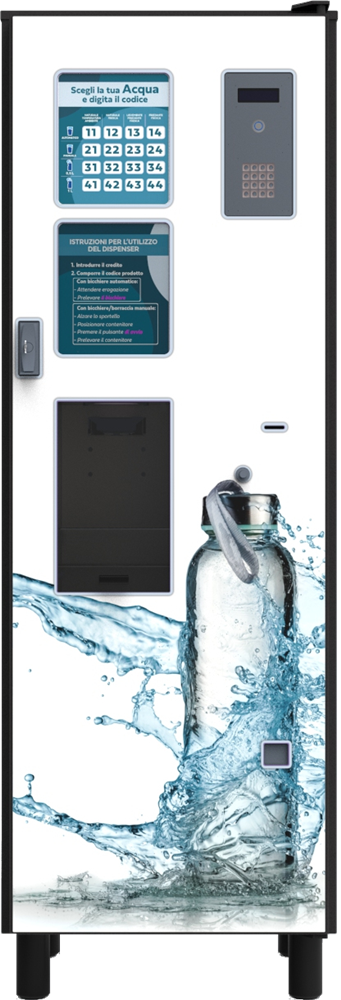
In 2016, one of Italy's leading confectionery companies contacted us with a new project: they wanted a more compact water machine that could dispense only still water, no gas.
Given the substantial numbers involved, we invested in completely redesigning the machine frame, and that is how Aquamat mini was born, capable of dispensing only cold and room temperature still water with a maximum of 160 cc.
This particular model was intended for apartment buildings and/or companies to replace the classic plastic bottles that were sometimes knocked over and did not always offer fresh water at the time of dispensing.
The Acquamat and Acquamat mini dispensers are a classic example of how customization can become a success.
In response to market demands for greater sustainability, we have developed other eco-friendly dispenser models.
Other eco-friendly models
In addition to those described above, in subsequent years we have developed other sustainable dispensers, including our protein models and water modules.
The first ones were developed in 2015 at the request of a customer who wanted to eliminate traditional bottled protein drinks from their customers' gyms.
This way, each customer always had their own drink dispensed on demand and in the desired quantity.
This dispenser was so successful that its fame spread to other parts of Europe, such as Poland, Hungary, and England.
In addition to the classic freestanding model, over the years we have also developed a tabletop model.
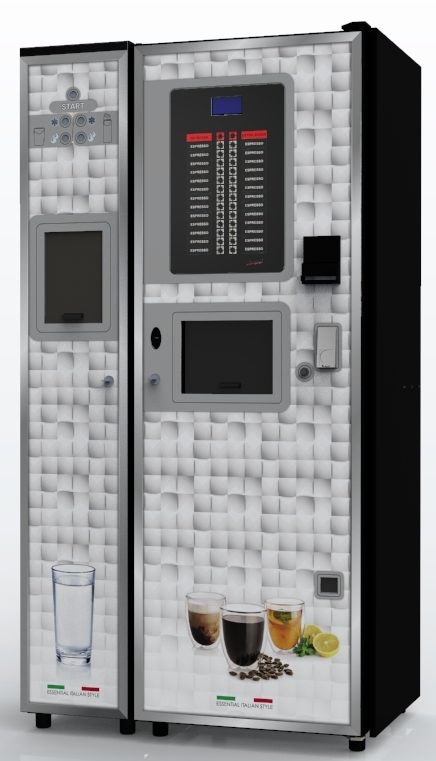
Given the success of these models, in 2021, despite the difficulties of the period, we sought to expand our range by adding water modules to the traditional freestanding models so that we could offer treated water alongside traditional hot drinks.
The module is designed to operate in “slave” mode, meaning it is only available alongside our automatic vending models.
To further reduce plastic waste, we always recommend that our customers use paper cups.
Conclusions
The vending sector is undergoing a profound transformation, in which sustainability and innovation have become central elements. Reducing plastic and focusing on consumption are now a real necessity, as well as an opportunity for growth.
The Aquamat and Aquamat Mini models demonstrate how customization and listening to the market can give rise to successful solutions that meet the needs of businesses, apartment buildings, and public spaces. The expansion of the range with protein dispensers and water modules confirms Flymax's commitment to developing eco-friendly systems.
Investing in sustainable solutions means looking to the future of vending in a responsible way, offering efficient, practical, and increasingly environmentally friendly products.
Contact us if you are looking for a company that is always ready to change in line with market needs.